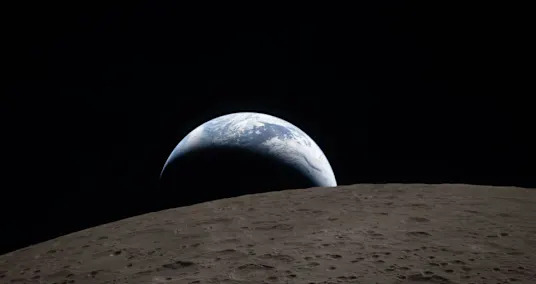
It was a moment for the history books: The Artemis II mission performed its much anticipated lunar flyby yesterday, and came within just 4,067 miles of the moon.
While soaring aboard their Orion capsule beyond the far side of the moon, the crew also reached an estimated 252,756 miles from Earth, breaking Apollo 13’s record for the farthest humans have traveled into space.
The flyby lasted seven hours, during which the astronauts could enjoy views of the lunar surface previously unseen by human eyes, with about 21% of the moon’s mysterious far side illuminated by the sun from the crew’s perspective.
Communications stopped for about 40 minutes during Orion’s transit behind the moon. The crewmembers saw Earth appear to set behind the moon, not dissimilar to what the Apollo astronauts witnessed in 1968. They were also treated to a very special solar eclipse.

After the flyby, Artemis II Commander Reid Wiseman thanked the NASA science team for putting together such an exciting observing program for them, as well as “some great, truly human experience moments here.”
“We were well prepared, and we appreciate all of you, and this is what we do best when we all come together and work as a team,” Wiseman said. “So y’all knocked it out of the park. Thank you for giving us this opportunity.”
Science officer Dr. Kelsey Young shared these comments with the crew: “I can’t say enough how much science we’ve already learned and how much inspiration you’ve provided to our entire team, the lunar science community and the entire world with what you were able to bring today. You really brought the moon closer for us today. And we cannot say thank you enough.”
The crew took thousands of photos that will help inform scientists’ understanding of the moon and its origins — and lay the groundwork for future missions to the lunar surface.
unknown content item
-
“You know from your experience of seeing the Earth from space how it just seems different,” said Canadian Space Agency astronaut Jeremy Hansen, while speaking with NASA Administrator Jared Isaacman about the flyby.
“When we were on the far side of the moon, looking back at Earth, you really felt like you weren’t in a capsule. You’d been transported to the far side of the moon. And it really just bent your mind. It was an extraordinary human experience. We’re so grateful for it.”
For more CNN news and newsletters create an account at CNN.com
LATEST POSTS
- 1
 The most effective method to Pick the Right Volvo XC40 Trim for Your Way of life
 - 2Phonetic Associations: A Survey of \Interfacing Worldwide People group\ Language Trade Application
- 3Individual Preparation Administrations to Raise Your Wellness Process
- 46 Top of the line Lodgings All over The Planet, Which One Do You Concur With
- 5The Tradition of Stone: A Gander at Notable Structures Through the Ages


- Geomagnetic storm grounds launch of Mars space weather satellites
- Illegal entries into Germany halve over two years, border police say
- MEPs urge Commission leaders to stop Russia from returning to the Venice Biennale
- Investigate Something else for Less: Financial plan Travel Objections
- Ukraine proved this drone-killer works. Now, the West is giving it a shot.
- Radiated Tortoise Faces Rapid Decline in Madagascar
- The Best 10 Innovation Developments of the Year
- Instructions to Upgrade the Mechanical Highlights of Your Shrewd Bed for a Superior Night's Rest
- Barry Manilow reveals lung cancer diagnosis and plans to undergo surgery: 'It's pure luck' it was 'found so early'